Saturday, 26 October 2013

My Twitter Experience.

It has been a while since I last wrote a blog post here, mainly because although I have so much to say I'm never quite sure where to begin However, I have an awful lot to say about Twitter and my experiences with it and in light of Monty Don's piece in Gardeners World magazine I thought now would be as good a time to say it as ever.
Primarily, as it appears to me, Monty is not comfortable with social media per se. He says that the sound of silence is the best sound of all, which may be true for him, but certainly is not for many, including often me. He also says that he thinks the reason there are few Twitter gardeners are that most gardeners fall into the over 50 age bracket and so are not comfortable with computers, a point that has very beautifully been written about by Sue Beasley at www.lodgelanenursery.blogspot.co.uk. But mainly the piece is not one which might make you join Twitter and certainly doesn't tell of the amazing gardening community that is there.
So let me tell you about my Twitter experience. When I first joined Twitter I was working at an awe inspiring nursery as a grower and manager and although I loved my job, was being bullied within the workplace and suffering as a result of that. I joined Twitter on a whim, and then realised that there were lots of gardeners there, both well known and not, who were sharing information and photos and generally being as gardeners usually are- nice! One of the first conversations I had was with James Alexander Sinclair, which nearly made me fall off my chair with astonishment. And so I got drawn in, spoke to people, the same people very regularly as well as others not so often. I was lucky in that I worked at a nursery which always had a stand at Chelsea and so every year people would come along and visit me at the stand and we would disappear off for coffee, chats and general friendliness. I met people that I had spoken to on Twitter because whether in life or behind a computer screen you vere towards your type of person, your type of friends. I can honestly say I have never met anyone from Twitter with whom I didn't instantly connect, and they have been gardeners and non-gardeners.
So that is all positive but it goes further. Twitter is an excellent marketing tool and that works in two ways. People use it to sell their business or themselves, but they can also find people who can enhance their businesses. If it wasn't for Twitter and the wonderful @TheFlowerFarmer, aka Georgie Newbery, I would never have given my first workshops and if it wasn't for the amazing @EmmmaB I would never have had the confidence to go out there and become the self employed person I am today. In fact I am just now beginning a new venture with a fellow Tweeter which would never have happened if we hadn't met through Twitter and then met-follow @SomersetFlowers for more!!
If I hadn't met a wealth of people on Twitter who respect me for my knowledge and experience as I do them for theirs, I can honestly say my life would be very different today, and I know in a negative way. Twitter has given me confidence, picked me up when I've been down, joined in when there have been things to celebrate, held my hand in times of stress and offered support in times of need. I have met, broken bread with, in real life, probably more than 100 of the people I regularly tweet with, and have formed what will be lasting friendships. I would never have met these amazing folk without Twitter.
But Twitter has taught me things too. It has taught me the importance of being nice, of offering help and support to others who are in need and never being afraid to be there for others as they are for you. It has also taught me that my knowledge, understanding and experience of gardening and the horticultural world is there to be shared, which I love to do. And it has given me the confidence to shout out if I have issues with things which brings me on to #shoutyhalfhour.
The last paragraph of Monty's article alludes to people being rude to him via Twitter. #Shoutyhalfhour is most certainly not anything personal towards him, but is a light hearted, mainly, and occassionally irritated, look at Gardeners World through the eyes of people for whom, as a programme, it simply does not work. We won't go into the whys and wherefores here, but that hashtag alone shows there is an enormous gardening community on Twitter, many of whom join in and some of whom don't. But it is proof that they exist. And following a short episode when Monty followed me, I am aware that he is aware of it. The cynic in me says his article actually is saying that "nothing to see here, move along", which would be sad as the more knowledge that we can find on social media sites the better as far as I can see.
So my advice to people is this. Join Twitter, join in with conversations, be genuine and it will enhance your life at the very least and if you are as lucky as I have been, and allow it to, it will change your life forever.

Saturday, 17 August 2013

<a href="http://www.bloglovin.com/blog/3849891/?claim=5wtbqnqhzvb">Follow my blog with Bloglovin</a>

Tuesday, 10 July 2012

A Day Out at Swines Meadow Farm Nursery

A great display of Begonias At Swines Meadow
When I first joined Twitter one of the first people I started to follow wasd @rareplants, who runs the wonderful Swines Meadow Farm Nursery in Market Deeping in Lincolnshire, along with his wonderful wife Karan. In time I came to learn that behind the Twitter name is Colin Ward, a brilliant plantsman who quite honestly knows more about plants in his little finger than I do in my entire body.

Last weekend Colin held the second of his two plantfairs this year. Lots of nurseries reasonably close to Colin had stalls and there were some excellent plants for sale as blogged by @papaver. However, as a plantaddict I was far more interested to see what Colin had on offer as he seems to be a master in finding slightly different varieties from the norm and growing them amazingly, as with the display of Begonia above.

Swines Meadow has a great selection of Ginkgo varieties for sale
In the outdoor beds there are a fantastic selection of herbaceous plants and grasses alongside some amazing trees such as the Ginkgo above, and a spectacular variegated Liriodendron. There are also lots of fruit trees and an incredible selection of bamboos. All the plants, whether large or small, are beautifully presented and look healthy and amazingly fresh which has been a difficult thing to achieve in the dreadful season we have had this year.

Once inside the greenhouse that is open to visitors there is an incredible range of  plants which range from annuals to perennial Begonias and ferns, along side some less hardy plants such as Fuchsia arborescens, which will need to be brought in over the winter months.

The greenhouse full of great finds.

Colin and Karan propagate lots of the more unusual plants at the nursery, growing lots from seeds, cuttings and division. If you get the chance to visit the inner sanctum, where all the plants are brought on, you will find a treasure trove of wonderful and unusual plants. I came away with an Akebia pentaphylla, a very rare and unusual Akebia which is an incredible plant and which Colin has propagated from his own stock plant.

I could go on and on about the plants which are available at Swines Meadow but rather than bore you I would implore you to go and have a look at www.swinesmeadowfarmnursery.co.uk, where you will see the range of plants that are available. Mail order is available too!!

To finish your visit please go and look at the amazing garden that Colin and Karan have created as it not only gives ideas on how to integrate plants bought at the nursery into your garden, but is an amazing and beautiful space to just be in. So I will finish this post with a selection of photos taken in the garden on Sunday.

Finally, please look out for nursery folk such as Colin and Karan. It's very easy to go to your local garden centre and buy plants that have been imported through Holland  but unless we support our British nurserymen and women and buy British grown plants, we will lose these wonderful folk and their knowledge.

An enormous Tetrapanax Rex

Cornus contraversa Variegata or the Wedding Cake Tree
Paulonia tomentosa cut back to create the huge leaves
Huge caulms of Bamboo

Thursday, 5 July 2012

A Very Victorian Fantasy in Bournemouth

The dark side of Bournemouth Borough Council's planting scheme

Before you ridicule me for adoring this garden, stick with me and I will explain why. Although firstly, having spent some time talking with the ladies on the stand on Monday, who seemed genuinely amazed and entralled that the garden looked so great, I need to explain a little about the garden.

Bournemouth, the land of holidays at the beach, donkey rides and ice cream, has a darker literary side which I for one knew little about. Mary Shelley wrote "Frankenstein" there  and is buried in a graveyard there, where the sculpture in the centre, by Bournemouth artist Andy Kirkby, will end up after the show is dismantled. Robert Louis Stevenson also wrote "Jekyll and Hyde" there and the two planting schemes are mirrored by those characters in ways which will become apparent.

The garden is split into two halves. In the half shown in the photo above there is very typical Victorian seaside parks and gardens planting, with Coleus, Ricinus, Cannas and countless more annual bedding varieties that the Victorians loved. The colour is deep and rich and screams of bedding schemes in the days where parks and gardens departments trained the horticulturalists of the future(it's where Alan Titchmarsh amongst others began his career), and draws the eye into it. It has a tropical feel that today can be seen in places such as The Exotic Garden at Great Dixter, but has been refined for today's taste, whereas this is true Victorian bedding at its best.

Both sides of the planting scheme
The opposite side of the bedding, or the opposite bed, is entirely white in its flower colour, calling in the lighter side of the Victorian arts such as Aubrey Beardsley's Art Nouveau works. It is gentle and innocent, with huge drifts of Cosmos, Orlaya grandiflora and Antirhinums amongst other species. The quantity of plants used gives the illusion of a huge billowing drift of white cloud atop a green background and is almost heavenly in appearance.

In both beds are willow sculptures by Stephan Jennings. In the sub-tropical, dark bed these are in dark willow figures, demonic in their appearance, whereas in the white bed they are of pale willow and are fairy like and innocent.

Victorian style bedding at its best

So why then, do I think this garden worthy of a blog post? Well its really simple. I stood in front of it saying"Oh look, seaside bedding" long before I knew that the garden had anything to do with Bournemouth Borough Council. It dragged me back to childhood holidays and days out at the seaside. The planting was stunning and all of the plants were produced in Dorset, continuing the tradition of producing your own plants for display. In essence, it was honest. And very beautiful.

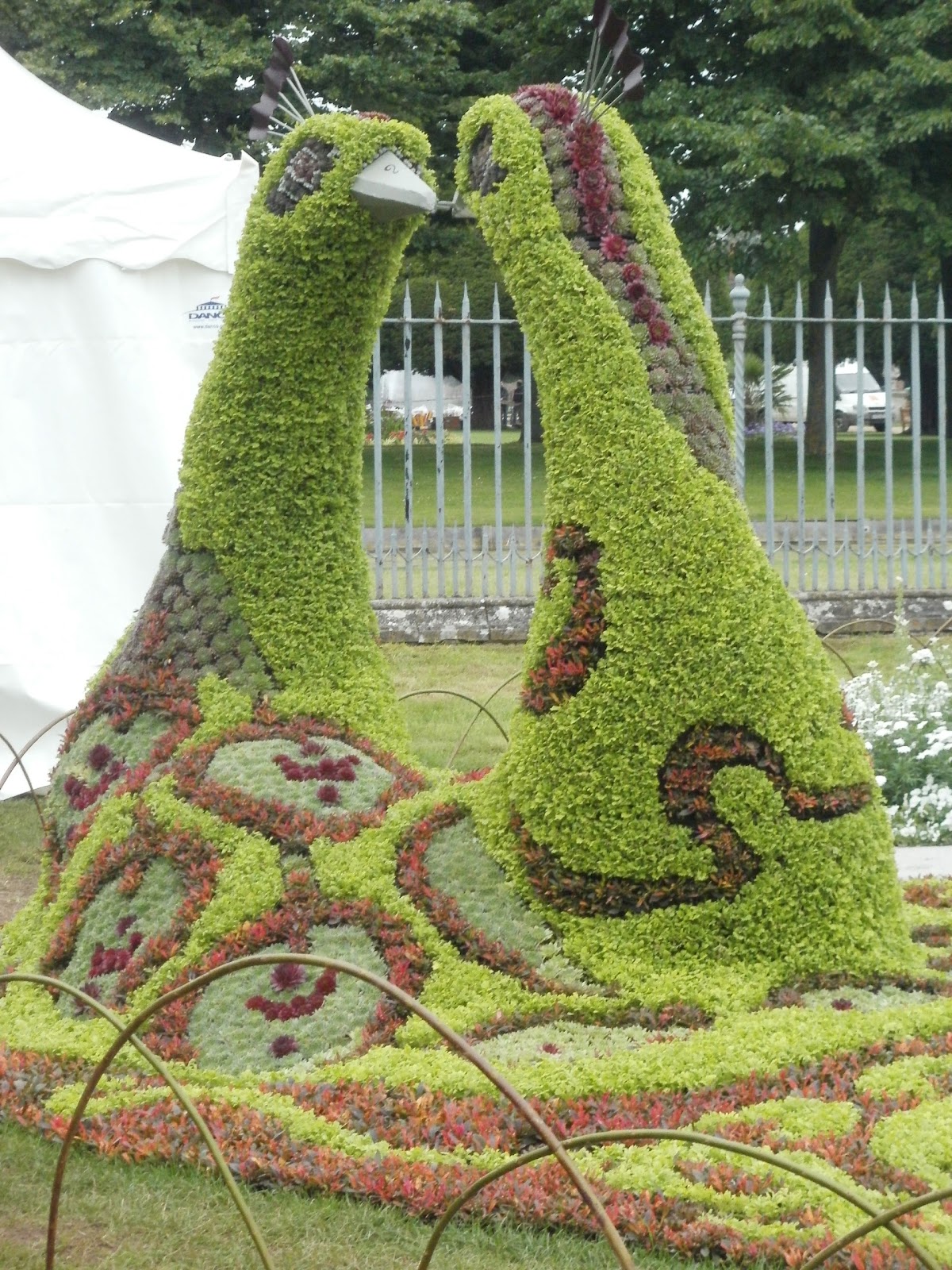
These peacocks were planted with amazing succulents

My feeling with this garden was also that the gardener could get planting ideas from this garden that are actually steeped in the horticultural history of this country. Unfortunately due to budget cuts the vast majority of Parks and Gardens departments no longer exist in the way that they used to, meaning that our industry now really struggles to find young people good training schemes and has lead to a real lack of skills in horticulture in the UK. So this garden not only talks of the Victorian history of Bournemouth, but also of the horticultural history of the UK both in the history of gardeners and gardens. And when you look at this garden it is truly apparent that the loss of the Parks and Gardens departments throughout the country has lead to our outside town and city spaces being  poorer and sadder places. It was amazing to see this piece of horticultural history displayed in such a fantastic garden. Thanks Bournemouth.
Drifts of white

Tuesday, 3 July 2012

Growing for Taste at Hampton Court

Panting to make you weep with joy at The Garlic Farm


I was immensely excited to be granted a press pass to Hampton Court Flower Show this year, mainly as I had never been to this show before and I was interested to compare it with Chelsea which I have been involved with at work for years.

The show at Hampton Court is enormous and I really was not prepared for the amount of stalls and stands selling what can, kindly, be described as garden accoutrements. But at least now if I need a metre tall dragon breathing fire and made of metal I shall know where to go. If I'm honest I felt a tad overwhelmed by the sheer size of it and was very glad to have Emma Bond with me.

Now I could go on all day about what I did and didn't enjoy, and there will be subsequent posting once I've finished giving it thought, but the marquee that I adored far beyond anything else was the Growing For Taste marquee.

Walking in the first thing seen was the garden created by The Garlic Farm on the Isle of Wight which went on to win a gold medal and best exhibit in the marquee. To quote Emma Bond, "the planting made me want to weep", as it was a stunning mix of Verbena bonariensis at the back, coming down to flowering Elephant Garlic and Ammi majus. There was a beautiful white rose in the mix as well and this all surrounded a seating area which was set for lunch. On the roof of the seating area were garlic bulbs drying in lines of different hues and all in all it was somewhere I could have sat for hours. It was amazing.

Garlic bulbs can be ordered for atumn delivery at www.thegarlicfarm.co.uk

Lunch at The Garlic Farm


Blackmoor Fruit

Blackmoor fruit also had created a wonderful display, showcasing how easy it is to include fruit growing in the smallest of spaces, such as a front garden. I really enjoyed seeing the different fruit training techniques used as well as the use of containers I also loved the use of the walls for training the plants against as its a very useful thing to remember is possible no matter how small the space you have is. They send out plants by mail order and I can personally vouch for them as I have bought several things all of which have arrived very quickly and established well. www.blackmoor.co.uk

Beehive composter and glasshouse at Pennards

Pennard Plants, as usual had a wonderful display of crops growing in raised beds in a real vintage style garden. It's no secret that I love this style but I have to say I often think Pennards are overlooked as their stands are always fantastically put together and the plant material always top quality.

Raised beds at Pennards

Plus I really believe that many people think that to grow food of any kind that you need lots of space and all the stands showed, very clearly, that that really isn't the case and that any space can be made suitable for some sort of edible plants.

Herbs and Beans Christmas cropping display
Herbs and Beans are a nursery that are new to me and I was particularly impressed by the way in which the stand was set out, showing what type of herbs and vegetable to grow for different purposes, for example to attract bees. The most brilliant section was the section that was named Leafy crops for Christmas which showed a variety of crops to plant in August/September that will crop throught to December and possibly beyond.


 But finally I must talk about the Otter Farm stand. Anyone who follows Mark Diacono on Twitter knows what a great and funny guy he is, and as I had hounded him to follow me, which bless him he did, I was excited to see what he had produced. Otter Farm is the countrys first climate change farm, growing crops which may end up being the norm in the years to come (as long as this year doesn't become the norm and we all revert to growing crops that enjoy the deluge). So I expected interesting plants, but I wasn't expecting the beauty and lushness of the planting. There were fruiting apricots and nectarines, lush growth from Japanese gingers, amazing Egyptian Walking Onions and the most amazing mature Sechuan Pepper that was at least 8ft tall and would make a beautiful multi stemmed tree in a small garden that couldn't cope with anything much larger.
Sechuan Pepper
But what The Otter Farm stand really showed is that Forest Gardening can be not just productive but absolutely beautiful as well and that an awful lot is possible in a relatively small space. So follow Mark on Twitter (@MarkDoc) and watch out for any talks or courses he gives as he's a very interesting chap who knows an awful lot as well as being quite funny, very amusing and charming.

Otter Farm provide mail order plants and seeds www.otterfarm.co.uk, where Mark also writes a great blog
The stunning Otter Farm Stand

Oreganum Beauty of Kent

And finally I would just like to show you this plant. It's called Origanum Beauty of Kent and the bracts look like hop flowers. And its available from Pennards Plants who do mail order at www.pennardsplants.com and is just absolutely stunning. They are also available at the show.


Saturday, 9 June 2012

The Chelsea Chop

So. as those of you who follow me on Twitter will already know, I had some slight issues with the way the concept of the Chelsea chop was explained on Gardener's World on Friday 8th June. 140 characters is just not enough to explain why so I have decided to blog on the matter as I have had enough of people being given incorrect information. The comment that set me off was that the Chelsea chop was to be performed in the weeks following Chelsea Flower Show. this is just not true as the concept is that Chelsea Flower Show is the reminder that the chop needs to be performed forthwith, and with good reason which I will come to.

 So what is the Chelsea Chop? Well as we all know, summer flowering herbaceous perennials such as Heleniums, Lysmachia, Sedums and countless more, like to grow upwards really fast as the daylight hours lengthen, and can very easily get to the point where they are getting unruly and falling over, even before they have flowered. So the idea of the chop is that the plants get cut back, whilst the daylight hours are still lengthening, in order that they don't collapse, but also, and far more importantly, so that they plant breaks from buds under the site of the pruning and becomes a bushier and therefore easier to control specimen. Many people like to perform this in mid-May and put any staking into the ground that they are going to use at the same time. The important thing to remember is that this can actually be done a number of times. Take, for example, a Verbena bonariensis that you have lovingly raised from a seed. It will want to grow upwards as a single stem. However, this is no good to anyone as no sooner that it gets wobbled by the wind it will be over on its side and it also will just be a single stem with a flower on top. So. once the seedling has three or four sets of true leaves, cut it back above its second set of leaves and the buds there will then move into action and break so that it has two stems. Do this again and again as the plant grows and you will end up ith a beautiful, multi-branched plant that is not so tall it needs its own scaffolding system to keep it upright and which will produce multiple heads of flowers. Each time you cut for cut flowers in the house it will break again and become a better and better plant. As growers we do this with all herbaceous stock in order to produce quality plants.

 Earlier in this tome I mentioned the importance of daylight hours and I shall now explain why. The "thing"with plants is that they are far more aware of the seasons than we are. In order to get all plants growing at their optimum daylight hours need to be long, so your herbaceous border knows that even though it might be a nasty wet day that it is still the beginning of June due to the fact that it's light for a long time. Its at this time of year that plants put on leaf, grow upwards and in summer flowering perennials in particular, get themselves to the point where they will begin to think about flowering. Timing your chop is vital as the plant will sulk for a week or two afterwards and you need it to get going again before the summer equinox at the end of June when the daylight hours decrease and the plants realise they need to flower and set seed. Therefore, in the UK, a month before this date is Chelsea week, and hence it is a good reminder that actually it is really last chance time. Obviously, if you have plants that have fallen after this date then cut them back as it will do no harm to the plant, but you may forgo many flowers that season.

 Also commented on was the idea that one plant can be cut back to different levels for flowers in succession, rather than all at once. This is a great idea but I must offer one word of advice. Once the plant has flowered once, if you let it set seed it will be very slow to flower again and you will be disappointed by the second and third flushes. This is easily overcome by making sure that you deadhead the plant before it sets seed as this will fool it into thinking that it hasn't flowered and off it will go again. Finally please always make sure you prune plants back to a bud. Plant stems at the tips have growing hormones in them and you need to cut back quite close to the bud to push those hormones back into the buds rather than let them continue up the stem. Also if the stem is left too long you run the risk of bacterial or fungal infection getting into it and the plant dying or suffering due to that. Also always ensure that the prunings are removed and composted and not left in the plant. And be quite mean and tough, cutting back by at least half if you are only going to do it once. The plants and your garden will thank you for it.